Maple Documentation
See the “Getting Started with Maple” guide for a quick start; the troubleshooting page if you are having problems; the errata page for information on known issues and failure modes; and the compatibility page for advice porting Arduino sketches or to check if your favorite shield will work.
This page has detailed technical and electrical specifications, revisions, and hardware design files. The major Maple peripherals and features are documented on their own pages with code examples and electrical advice:
- i2c: a simple two wire serial interface (also called the twi: two wire interface)
- pwm: pulse width modulation, commonly used for motor and servo control as well as signal synthesis (sometimes falsely refered to as analog out; this is NOT a proper DAC (digital analog converter)
- gpio: general purpose digital input and output (digital read/write)
- usart: “universal” serial devices (not to be confused with USB)
- timers
- adc: analog digital converters for measuring voltage levels (analog read)
- spi: serial peripheral interface, yet another way to talk with external devices like SD cards
- jtag
- usb
If you are looking for the full programing language reference or information about the development environment you’ve come to the wrong place. But you can get there from here.
Full Technical Specs (Maple rev3)
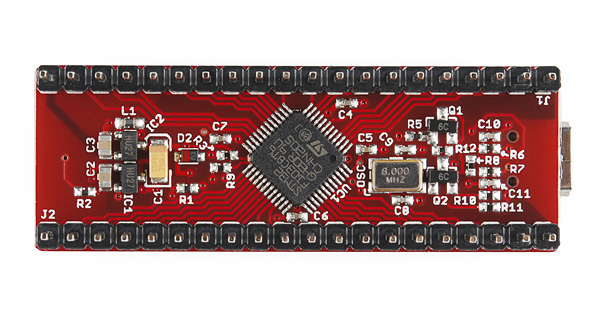
Microprocessor: STM32F103RB
The STM32F103RB is an ARM Cortex-M3 chip from ST Microelectronics; more details in the manufacturer’s datasheet. This can be a little confusing; ARM is a company from the UK which doesn’t actually produce chips; they just publish instruction sets and technical specifications, and sell reference designs to actual manufactures who implement their own version in silicon. All Cortex-M3 chips from any manufacturer (NXP and TI also make them) would thus supposedly be instruction compatible, but in reality the differences in how peripherals (like timers, interrupts, serial buses, etc) make code portability difficult. ST produces a number of Cortex-M3s (their STM32 line); this particular model is in their “medium-density performance line” and has the following features:
- 64 pins, 72MHz, 2.0 to 3.6v (“almost all 5v tolerant”)
- 128KB flash
- 20KB internal SRAM
- GPIOs toggle at up to 18MHz
- 51 GPIOs
- 2 12-bit ADCs, up to 16 channels (0 to 3.6v)
- 2 i2c interfaces (SMBus/PMBus)
- CAN interface
- 3 USARTS
- 2 SPIs
- USB
Electrical Power
The Maple can be powered from a USB host, a battery, the barrel jack, or voltage applied directly to a header (Vin). The power source is selected with a jumper. Additionally, a battery charging circuit allows an external LiPo battery to be charged from an alternative power source if the appropriate jumper is connected. Be careful setting up the power source! The errata page details some potential pitfalls.
The Maple accepts external voltages from 3.3 to 16 volts; the barrel jack connector has a reverse voltage protection diode that drops the voltage 2v, so up to 18v can be supplied via that connector. The battery circuit is designed for 3.7v LiPo batteries: don’t apply more than 4v to that connector (but you can, eg, attach a 9v battery as regular external power). There are two through-hole pads underneath the barrel jack connector that wires can be soldered to for applying external power. If you have a very well regulated 3.3v power source and are concerned about power consumption, it should be possible to apply 3.3v directly to the Vcc headers, but we don’t recommend it; 3.3v will go through the regulators just fine and should be applied to the Vin header pin.
Design Files
These files are released under the Creative Commons 3.0 AT-SA (attribution, share-a-like) license. You can see our most up to date development versions in our hardware repository.
- Download Maple rev3 schematics and layout (.zip for files for Eagle CAD; note that this 4-layer design is not editable in the free version. We are switching to the open Kicad EDA package for future designs)
- View Maple rev3 schematic (as .pdf)
- View Maple rev3 layout: Top, Bottom (as .png)
About
Contact
Community
Distributors
Licensing
Feeds
Search
Contact webmaster@leaflabs.com with website issues
Powered by WordPress, nginx, Linux, vim, and coffee.
This site intended to be valid HTML 4.01 Strict. Best viewed with any standards-compliant browser.
Copyright LeafLabs LLC, 2009-2010, a member of the
Green Street Space.
Unless otherwise noted all content on this website is released under the
Creative Commons Attribution Licence 3.0
Hello Anonymous! Login?